Are Motorized Bicycles Street-Legal in Kansas?

Posted August 19th, 2010 @ 12:23 pm by Randy - Filed under: In The News,Kansas

The Salina Journal is reporting that police in Salina, Kansas are cracking down on motorized bicycles:

Cole Rodenbeek says he and some friends who ride their bicycles to work are being eco-friendly and trying to save money on their daily commute to work.

But Salina police say he and his friends are breaking the law. It’s the motors on the bikes the Salinans ride that have drawn law officers’ attention.

Equipped with 49 cubic centimeter motors that get as much as 175 miles to the gallon of gas, their bikes can cruise at 20 miles an hour along the street or faster downhill.

Recently, one of the riders was stopped by a patrol officer and given a ticket for riding an unregistered vehicle on a city street. The fine in Salina Municipal Court for driving an unregistered vehicle is $50, and court costs are $50.

Officers aren’t against saving fuel. But the law says that any vehicle driven on a street has to be registered and have a license tag, said Lt. Russ Lamer, traffic unit commander.

A motorized bicycle doesn’t have a vehicle identification number, so it can’t be registered, Lamer said. The same holds true for golf carts, which also are illegal to operate on Salina streets, he said. Mopeds have VINs, so they can be registered.

Bicycles powered by electric motors also would not be legal to drive on city streets, Lamer said. [Read more]

Here are the Kansas Bicycle Laws and Statutes related to motorized bicycles:

8-1592a. Application of 8-1586 to 8-1592 (bicycle-specific statutes) to motorized bicycles.
The provisions of K.S.A. 8-1586 to 8-1592, inclusive, shall be applicable to motorized bicycles, and every person operating a motorized bicycle shall be subject to the provisions thereof.
8-1592b. Electric-assisted bicycles; traffic law application; no registration or driver’s license required.
Vehicle registration and driver’s license shall not be required for operation of an electric-assisted bicycle. Traffic regulations applicable to bicycles shall apply to electric-assisted bicycles, except tricycles with no brake horsepower.
8-1439a. “Motorized bicycle” defined.
“Motorized bicycle” means every device having two tandem wheels or three wheels which may be propelled by either human power or helper motor, or by both, and which has:
(a) A motor which produces not more than 3.5 brake horsepower;
(b) a cylinder capacity of not more than 130 cubic centimeters;
(c) an automatic transmission; and
(d) the capability of a maximum design speed of no more than 30 miles per hour except a low power cycle.
8-1489. “Electric-assisted bicycle” defined.
“Electric-assisted bicycle” means a bicycle with two or three wheels, a saddle, fully operative pedals for human propulsion, and an electric motor. The electric-assisted bicycle’s electric motor must have a power output of no more than 1,000 watts, be incapable of propelling the device at a speed of more than 20 miles per hour on level ground and incapable of further increasing the speed of the device when human power alone is used to propel the device beyond 20 miles per hour.

Here’s what the Kansas Highway Patrol says about motorized bicycles (and Mopeds):

Are Motorized Bicycles Street-Legal in Kansas?“Motorized bicycle” means every device having two tandem wheels or three wheels, which may be propelled by either human power, helper motor, or by both and which has:

  • A motor which produces not more than 3.5 brake horsepower;
  • A cylinder capacity of not more than 130 cubic centimeters;
  • An automatic transmission; and
  • The capability of a maximum design speed of no more than 30 miles per hour except a low power cycle.
  • * The operator must possess a valid driver’s license for any class of motor vehicle, or a driver’s license specifically for the operation of a motorized bicycle per KSA 8-235. [read more]

And here’s what the Kansas Department of Revenue says:

A motorized bicycle manufactured in 1980 or after must have a seventeen (17) digit VIN conforming to the National Highway and Traffic Safety Administration requirements. There must also be a decal or plate attached with a statement that the motorized bicycle meets the Federal Safety Standards. If the motorized bicycle does not meet these requirements, it more than likely will be considered a “toy vehicle” which will not be titled or registered in Kansas and cannot be operated on public roadways within Kansas.

In addition, a motorized bicycle must meet the following requirements: have two tandem wheels or three wheels which may be propelled by either human power or helper motor, or by both, and which has all of the following:
(a) A motor which produces not more than 3.5 brake horsepower*;
(b) a cylinder capacity of not more than 130 cubic centimeters;
(c) an automatic transmission; and
(d) the capability of a maximum design speed of no more than 30 miles per hour.

If the vehicle does not have every one of these requirements, it will not be titled or registered in Kansas. If the vehicle exceeds any of the number values or has a manual transmission, it will be considered a motorcycle and will be titled and registered as such.

How do I get a license to operate a Motorized bicycle (Moped)?
Provide acceptable proof of identity. Pass a vision test and written test.

Seems like there’s some degree of fuzziness and inconsistency among the various agencies. Add in the possibility that different municipalities may have different statutes, and the situation is pretty confusing all around.

But it appears that Lt. Russ Lamer with the Salina Police Department is correct: Motorized bicycles (powered by an internal combustion engine) need to be licensed and registered. And since bicycles don’s have a VIN (apparently the bicycler serial number doesn’t suffice), they can’t be registered.

But his second statement, that “Bicycles powered by electric motors also would not be legal to drive on city streets”, seems to be contradicted by state statute 8-1592b which clearly states that “no registration or driver’s license required” (as long as it can’t go faster than 20 MPH).

The bottom line: Motorized bicycles are (probably) not street-legal in Kansas!

So just ride a normal (human-powered) bicycle and avoid the whole issue. Pedal bicycles do not require license or registration (except in a few communities). Plus, they’re far less expensive, and much better for your physical and mental health!

Should the De Soto Bicycle Ban Be Lifted? Vote!

Posted July 24th, 2010 @ 8:25 am by Randy - Filed under: In The News,Kansas

De Soto Bicycle BanFor a number of years, the community of De Soto, Kansas has banned bicycles from 83rd Street in their town, citing safety issues on a two-lane road with no shoulders.

Last week, the city council in De Soto took another look at the bicycle ban, and decided to keep it in place:

The ban on bicycling on 83rd Street in De Soto, Kansas, was put in place by the city council several years ago.

About one year ago, the city council reconsidered the ban and decided to wait until a current construction project was complete before removing the ban.

Despite the promises to remove the ban when the construction was complete, last December, when the construction project was complete, the city reconsidered and decided to retain the ban.

Now the issue has come up again on the DeSoto City Council agenda for July 15th, 2010.

A committee recommendation was to lower the speed limit on 83rd Street so that it meets current engineering recommendations and simultaneously remove the bicycle ban. The recommendation was to enforce single file riding only for bicyclists.

The City Council decided to reject these recommendations and leave both the bicycle ban on 83rd Street and the current speed limit in place. The vote against changing the speed limit was 3-2. [read more from MoBikeFed]

De Soto Bicycle Ban PollFollowing the city council decision, the De Soto Explorer newspaper ran an online poll that asked readers to weigh in on the issue: “Would you like to see the bike-ban on 83rd street lifted?”

Over several days, and 175 votes, the tally came to:

  • 74% favored lifting the ban
  • 17% wanted to keep the ban in place
  • 9% weren’t sure

Gee, sounds like the people have spoken loud and clear. Is the city council paying attention?

Through the wonders of the web, you can now vote on the issue right here:

What do you think?

OK, so I suspect I know that you think. So vote, already!

Lawrence Police Seek Road Rage Driver

Posted July 20th, 2010 @ 8:45 am by Randy - Filed under: In The News,Kansas

Lawrence police are looking for a driver who assaulted a group of cyclists on July 15th, then drove away, leaving an injured cyclist and damaged equipment.

Lawrence Hit-and-Run Road Rage Driver On The LooseLawrence Cyclists on lookout for hit-and-run driver
The driver was apparently upset that he had to share the road with the bicyclists and appeared to have intentionally hit the lead rider, who fell from his bike. The injured bicyclist had scrapes to his back. His bike, his helmet and his clothes were all damaged. The driver didn’t stop, but instead took off down the road.

The driver is described as “a white male in his 40s, with dark blond, shoulder-length hair. He was reportedly driving an older model, four-door, black Chevy truck.”

Anyone with information should call Crime Stoppers at 843-TIPS.

Race Across America Cyclist Struck By Car in Kansas

Posted June 17th, 2010 @ 10:15 am by Randy - Filed under: Accidents,In The News,Kansas

Diego Ballesteros CucurullYesterday morning, just before 7am, a cyclist was struck by a car near the Sedgwick/Butler County line just east of Wichita. The cyclist was riding on the shoulder of the road when a car drifted out of the traffic lane and struck him from behind.

The cyclist was later identified as 36-year-old Diego Ballesteros Cucurull of Spain, who was participating in the Race Across America (RAAM) as part of the 4-person COANFI Desafio ASPANOA relay team.

Diego was life-flighted to Wesley Medical Center in “extremely critical condition”. Deigo was later upgraded to “serious condition” and remains at Wesley. RAAM reports that Diego underwent surgery at Wesley, and “his prospects for a full recovery are good”.

The COANFI team has withdrawn from the race.

The Race Across America started in California six days ago and will end in Annapolis, Maryland. The route through Kansas included time stations in Ulysses, Montezuma, Greensburg, Pratt, Maize, El Dorado, Yates Center, and Fort Scott. The race has been run since 1982, and riders compete in several classifications, including solo men and solo women, as well as 2-person, 4-person, and 8-person relay teams. Racers ride around the clock, sleeping when they can. Even for the riders on relay teams, RAAM is an incredible athletic challenge.

Here is a well-done video from KAKE TV in Wichita:

According to the reporter, RAAM rules require a chase car to follow behind cyclists at night, to shield them from traffic, but a chase car is optional during daylight hours. In this case, Diego’s car had driven a few miles ahead in anticipation of switching riders on the relay team.

As you can see from the video, the road here, Highway K-254, is a four-lane divided highway with wide shoulders.

Although rumble strips can be troublesome on roads with narrow shoulders, this is one situation where they might have made a difference.

The KHP crash report lists the driver as Keith J. Swoverland, age 22, of Wichita. There is no word yet on charges. According to RAAM: “Our understanding is that in cases like this the driver is not cited. The Kansas Highway Patrol turns the information over to the DA. The DA then decides what action should be taken. We’re confident action will be taken. Owing to the seriousness of the case, it’s not a simple speeding ticket.”

According to preliminary comments from the Kansas Highway Patrol, “By all indications, texting was not a contributing factor. The driver looked away from the road and veered onto the shoulder, striking the cyclist.” The speed limit on that stretch of K-254 is 70 mph, though patrol officials said they do not know for sure how fast the car was traveling when it struck Ballesteros.

Additional coverage:

Wichita Updates Their Bicycling Laws

Posted June 15th, 2010 @ 10:05 pm by Randy - Filed under: In The News,Kansas

This morning the Wichita City Council approved changes to the city’s bicycle ordinances to bring them into line with state bicycling laws.

The changes were proposed by the Wichita Police Department, with input from the general public as well as the Oz Bicycle Club and the Wichita Bike-Walk Alliance. The changes were proposed because the existing ordinances were not bicycle friendly and were difficult to comply with and enforce.

The updated ordinance (#48-754) eliminated the following from the city code:

  • Bicycle licensing requirements.
  • Requiring the use of a bike rack if parking within a city block of a rack in core area.
  • Requiring that police impound unsafe bicycles (and the associated $2 impound fee).
  • Requiring bicyclists to operate within five feet of the right hand of the curb or edge of the
    street.

Kansas State Statute KSA 8-1590 requires that bicyclists “ride as near to the right side of the street…as practicable” and “Wherever a usable path for bicycles has been provided adjacent to a roadway, bicycle riders shall use such path and shall not use the roadway.” The new City Ordinance changes incorporate this language to be consistent and in compliance with State Statute.

Here’s a copy of the proposed ordinance marked with changes, plus a copy of the approved ordinance, and the agenda item report.

According to the Wichita Eagle:

Bicyclists can ride on the street and won’t have to be within 5 feet of the curb anymore, unless there is a “usable” bike path next to the street.

That’s the primary impact of an overhaul of bicycle laws city council members approved unanimously this morning. The changes also eliminate the need to license bicycles with the city and the need to use a bike rack if one is available within a city block.

Bicyclists praised the changes and the city’s outreach to riders in crafting the law. But they questioned what the definition of a “usable” path is and how it will be enforced. City officials said it comes down to what a reasonable person would consider a “usable” path.

City Council member Jim Skelton said he believes riders should decide what is “usable.” “I don’t want to see a judge deciding what is usable,” he said. [ read more ]

It’s good to see Wichita synchronizing their ordinances with state statutes. Laws that vary from place to place only lead to confusion.

Bier Bike Coming Soon To Lawrence?

Posted June 9th, 2010 @ 7:29 pm by Randy - Filed under: In The News,Kansas

A new type of pedal-powered vehicle may be coming soon to Lawrence, Kansas — a trolley-sized pedicab that will carry up to 16 passengers. According to the Lawrence Journal-World:

The idea of a 16-passenger, pedal-powered vehicle in downtown Lawrence sounds OK to city commissioners, as long as it stays off Massachusetts Street.

Commissioners on Tuesday evening unanimously approved an ordinance allowing oversized pedicabs to operate in Lawrence, but added a provision prohibiting them on Massachusetts Street because the vehicles are expected to have a top speed of 5 miles per hour. [read more]

The “oversized pedicab” is described as a “unique trolley-looking device that features a bar-like table in its center, where patrons sit on stools and do the pedaling themselves while a professional does the steering and braking.”

Searching the web for pictures, I came across this video of a “beer bike” in Amsterdam:

And here’s a photo where you can see a few more details:

Lawrence Beer Bike

In Germany, this is known as a Bier Bike, and in the Netherlands as a Fietscafe. There’s also a company in Minneapolis that rents these contraptions, which they call a Pedal Pub.

Luke Stone, a Lawrence entrepreneur who hopes to start an oversized pedicab business by this fall, says that he originally wanted to allow people to bring their own alcohol onto the pedicab, but city attorneys determined that would violate state laws.

So, no beer on the “beer bike”. But it’ll sure be a fun way to travel between pubs!

Ride of Silence 2010 Wrap-Up

Posted May 23rd, 2010 @ 3:25 pm by Randy - Filed under: In The News

Here are a few reports from Ride of Silence events around the region:

Kansas City

In Kansas City, the Ride of Silence rolled on despite rain.

Learn more from KSHB-TV

Here’s a photo from the event (courtesy of Mark Rainey of Groody Bros. Bicycle Restoration Project):

Ride of Silence 2010 Kansas City

According to participant Bill Poindexter (carfree American), who ultimately ended up leading the ride, about 35-50 people attended the ceremony in Brookside, during which several people spoke about the purpose of the Ride of Silence, and a list of cyclists injured and killed in recent years was read. The official ride was canceled due to rain, but a number of people decided to ride anyway, and Bill led a slow-paced group ride from Brookside to the Country Club Plaza and back:

The rain fell steadily, but it felt appropriate for the nature of the ride, and there were no down pours. The ride was safe, without incident. Most thanked me after for leading the ride. I believe about 25 people rode. The reason why I spoke up and led the ride is: first the rain was mild, most of the riders were prepared for the weather, this is a memorial ride and there was no reason to cancel the ride portion. Before we rolled into the plaza, I told the riders, “If something ever happens to me, don’t use rain as an excuse not to ride for the Ride of Silence.”

Wichita

Ride of Silence Raises Awareness of Bicycle Safety in Wichita:

“I was hit by a truck from behind. He was estimated going 50 miles per hour at the time,” says Katharine Wencel who is recovering from her March 6th accident.

She can only watch as her fellow riders take part in the ‘Ride of Silence’ Wednesday night. The ride is a nationwide event meant to make drivers more aware of bicyclists.

Cyclists say things aren’t getting any easier With cell phones and other devices, drivers are more districted than ever before. “Most people are just distracted drivers in general,” says Wencel.

Before the ‘Ride of Silence’, the names of those hurt or killed on Wichita roads are read aloud. Cyclists ask that you pay attention, share the road, and remember that cyclists are people.

See also: Injured, killed bicyclists to be remembered with ride

Around the Region

Can Wichita Become Bike Town?

Posted May 21st, 2010 @ 7:27 am by Randy - Filed under: In The News,Kansas

This has been building for awhile, but it sounds like bicycling in Wichita is starting to gain momentum. The Wichita Eagle just published an editorial called Turn Wichita into bike town:

Bicycle WichitaThis is Bike to Work Day, Bike to Work Week and Bike Month in Wichita. The “I Bike Douglas” movement will kick off Saturday. Now, if only Wichita could become a bike town.

As the bicyclists at a community meeting Tuesday night described it, Wichita currently is a “car town” full of drivers with bad attitudes toward bikes.

Turning Wichita into a bike town would require more bike-friendly planning, including more bike lanes, paths and racks.

The proposed city ordinance updating bike rules will help, by junking the unused bicycle licensing system and, like state law, requiring bicyclists to “ride as near to the right side of the street … as practicable” (rather than, as now, within 5 feet of the right hand of the curb or edge of the street).

Wichita also might want to imitate Hutchinson’s new Public Bike Project, which will put specially painted bicycles around downtown for the sharing (or the taking, human nature being what it is).

I Bike DouglasBicyclist solidarity will be served by Saturday’s “I Bike Douglas” kickoff, with events including maintenance and safety clinics, a vintage bike display and three guided hour-long tours focusing on architecture, art and photography-friendly sites.

Of course, no ordinance or advocacy may help with the “bicycle haters,” as Wichita City Council member Janet Miller called them, who either don’t know or don’t care that cars and bikes alike have legal rights to the roadways and the responsibility to share them with caution.

But bicyclists are simultaneously getting exercise and acting to curb air pollution and the nation’s oil addiction. When they are on Wichita streets, they deserve respect, imitation and a wide berth. They do not deserve to be honked and hollered at as if they are somewhere they don’t belong.

Huzzah!

Wichita already has a lot of the elements of a bike-friendly community: a great groups of bike shops, enthusiastic clubs (Oz Bicycle Club, Coasters Bicycle Club, Kansas Singletrack Society), bike blogs (River City Cyclist, ICT Cycle Chic, Cycling in Wichita), an organization to promote bicycle commuting (Bike Wichita), a very good bike path system, cycling-friendly topography, and usually-reasonable weather.

So how does Wichita take the next step, from a place where cycling could be great, to a place where cycling is great?

It’s simple: Ride bikes.

The more people riding bikes, the more bike-friendly a community becomes. It can be tough to take that first pedal-stroke, but after that, momentum will come.

Get out and ride, Wichita!

More recent Wichita bicycling news: Make Wichita better for bicycles, Bicyclists bemoan ‘car town’ attitude at meeting, Wichita City Council to vote on bike laws, Wichita Council Defers Vote on Changes to the Bicycle Ordinance

Bike Sharing Comes to Hutchinson, Kansas

Posted May 20th, 2010 @ 8:20 am by Randy - Filed under: In The News,Kansas

From Hutchinson, Kansas comes news of a new bike sharing initiative in this south-central community of about 40,000 people:

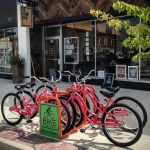
Hutchinson Public Bike ProjectDowntown Hutchinson is about to gain a few more residents.

Not business or people-type residents – but brightly colored bicycles that will be available for community use and sharing.

Jennifer Randall, who is helping with what has been called the Public Bike Project, will make the first three bikes available to the public during this week’s Third Thursday event.

“I have three tuned up and ready to go,” Randall said. “But this isn’t my project. This is Hutchinson’s public bike project. I just gave it a kick in the booty.”

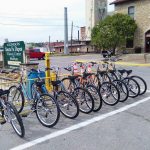
The idea behind it is to make available to the community around 10 bicycles that can be ridden from business to business in the downtown area and left in bike racks for the next person to use.

Be advised, however, they cannot be ridden on downtown sidewalks. City code prohibits bicycles, skateboards and in-line skates “upon a sidewalk within the business district or anyplace within Avenue A Park.”

“It’s not an original idea,” Randall said of the community bikes. “There are other communities that have implemented something like this. It basically just encourages people to bike and also encourages a sense of community in the sense that these aren’t any one person’s bike – they belong to all of us.”

Randall added that she’s hopeful that if the project is popular, it also will spur the city to put more bike racks downtown.

Read more from The Hutchinson News: Community effort steering downtown bicycle project

The bicycles have been donated by local businesses and individuals, and “have been painted by local artists so there will be no confusion about whether they belong to someone else or are part of the public bike project.”

There’s some concern about the bikes being stolen, but Randall is philosophical on this point: “If they do, they do. If someone needs one that bad, OK. We’ll replace it and keep trying.”

Bravo, Hutchinson!

Photo courtesy Sandra J. Milburn of the The Hutchinson News

Kansas is Suddenly Bike-Friendly

Posted May 19th, 2010 @ 2:04 pm by Randy - Filed under: In The News

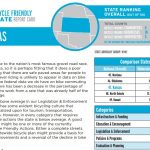
Bicycle Friendly StateKansas is way more bike friendly today than it was yesterday.

Yesterday, Kansas was number 33 on the League of American Bicyclists Bicycle Friendly State Rankings. Today, after the League’s 2010 state rankings came out, it’s number 13.

Gee, that was easy.

The Bike League evaluates a state’s commitment to bicycling and covers six key areas: legislation, policies and programs, infrastructure, education and encouragement, evaluation and planning, and enforcement. League President Andy Clarke highlighted that “several states dramatically improved their ranking by updating their traffic codes, increasing the level of funding for bicycle improvements, implementing education programs aimed at cyclists and motorists, getting organized and hosting their first statewide bicycling conferences and events.”

So what did Kansas do to merit a jump of 20 spots in the rankings? I have no clue.

On the six areas, here are Kansas’s rankings for the last two years:

Category 2010 2009
Legislation #13 #33
Policies & Programs #12 #40
Infrastructure #17 #28
Education #15 #22
Evaluation #19 #16
Enforcement #15 #19
Overall #13 #33

So Kansas dramatically improved almost across the board (except for “Evaluation”).

Hmmm.

Here are the rankings of our neighbors:

State 2010 2009
Arkansas #45 #38
Colorado #14 #13
Iowa #7 #6
Missouri #28 #17
Nebraska #43 #37
Oklahoma #44 #48

According to the Bike League, “The BFS program is revolutionizing the way states evaluate their quality of life, sustainability and transportation networks, while allowing them to benchmark their progress and work toward improving their bicycle-friendliness. The rankings are used to create momentum amongst states and communities to continue to become more bicycle friendly.”

Congratulations, Kansas!

Let’s keep it going!